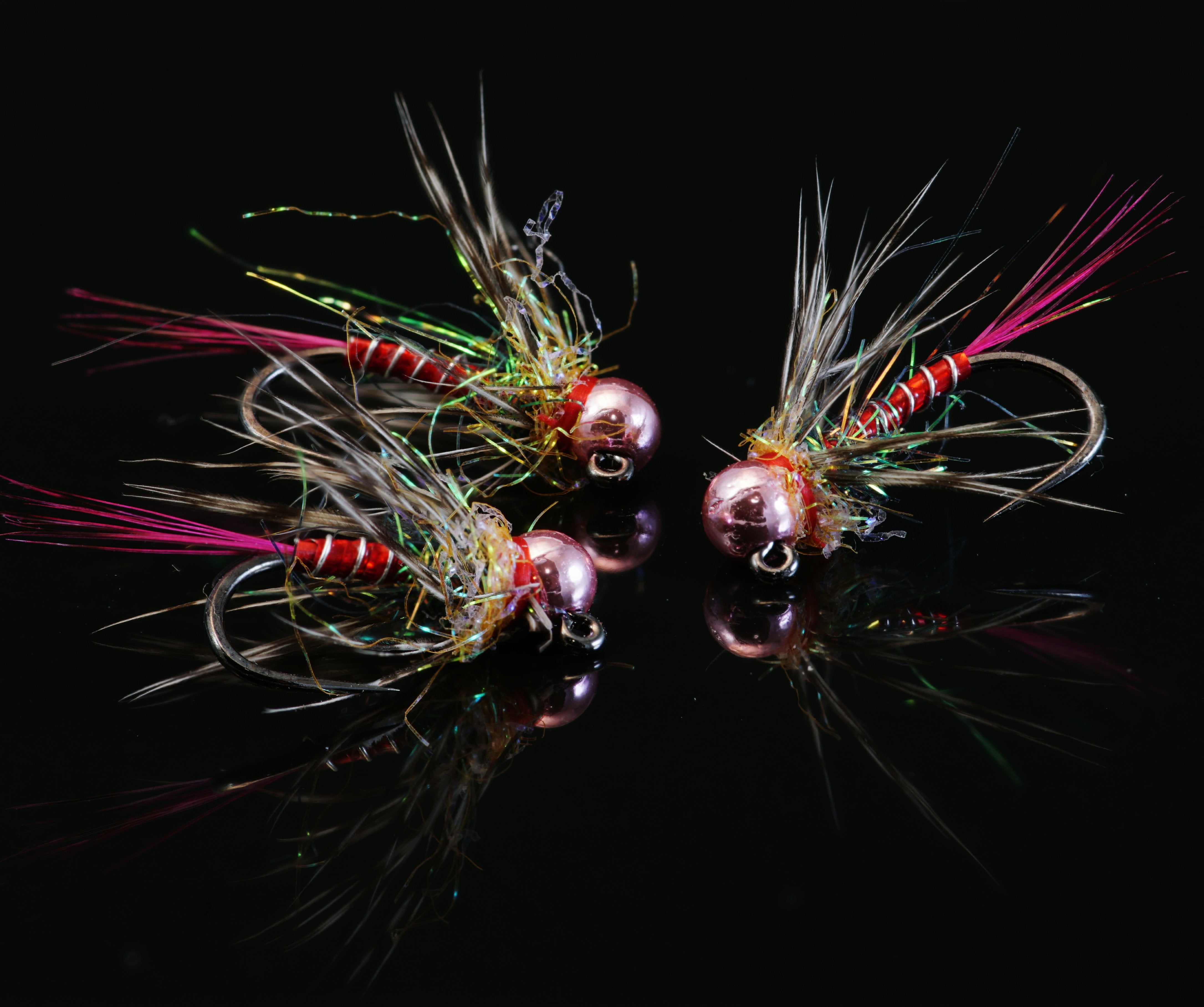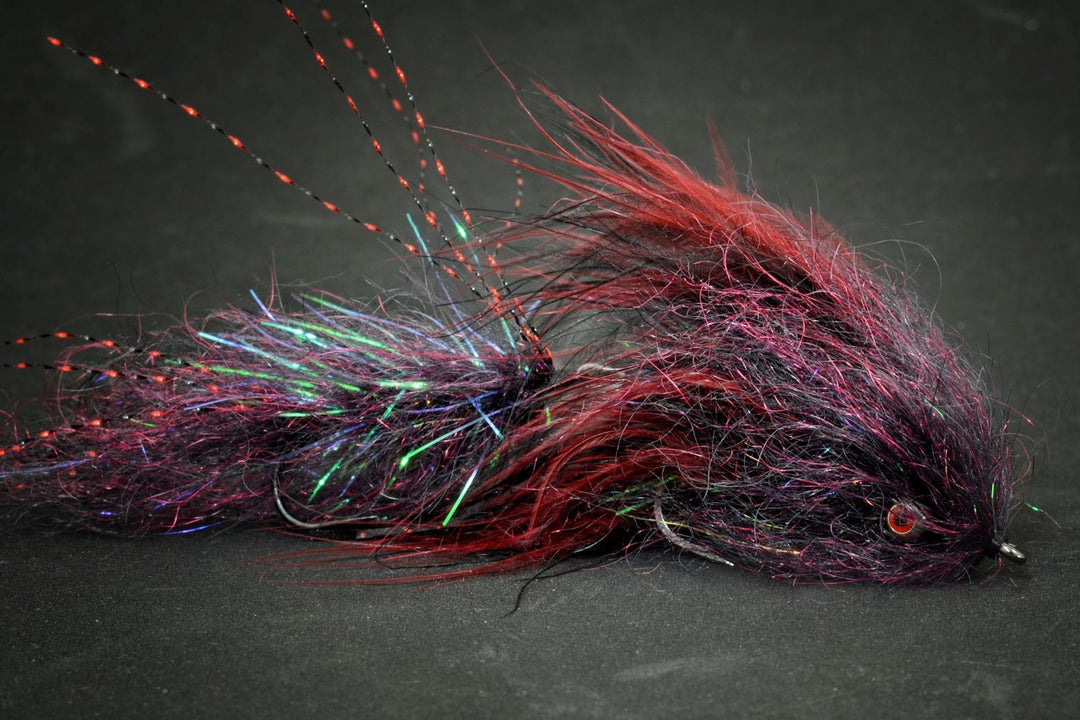
I was asked the other day about some of the patterns I'd found to be effective so far this spring. I rattled off a few patterns and then remembered several good fish that I'd taken on this nifty little PT variation. Nothing super-fancy, but a fun tie and it has a good little hot-spot. Plus, it incorporates some cool green dyed pheasant tail fibers.
For those of you that have been hiding under a rock or living in a bomb shelter for the past few years and hadn't heard about Tenkara fishing, get busy with Google. Regardless, I think the Tenkara style is something that is worth consideration. And while I haven't personally bitten the bullet to get setup, I can't help but try out the "backwards" hackled fly patterns. This was a recent attempt that came out of a combination of new materials I received from the crew at Hareline that screamed "Sakasa Kebari". The Sakasa Kebari (which means something like "Frozen Eyelashes" in Japanese) style Tenkara flies are a thing of beauty, while at the same time non-descript and fairly simple (my example here bucks the norm, just FWIW).
In all seriousness, these reverse hackle style flies are as effective as they are cool looking. Google up Tenkara style fly fishing or go see our buddies over at Tenkara Guides if you're interested in this effective style of fishing.
So besides the purple turkey biots (Hareline) and the Furnace India Hen, I used a cool new (to me) product called "Glo Brite Floss". It's bright and ties more like thread than it does floss. That's what is used for the head section above the hackle.
Hook: Daiichi 1250 (barbless glass bead hook) Thread: UTC Ultrathread 70 Denier, Purple Body: Purple Turkey Biot Ribbing: One strand of Crystal flash Collar: Chartruese Senyo Laser dubbing Hackle: Furnace India Hen Head: Glo Brite Floss, Purple
I think we've all had those days when the fishing was so-so until we dialed in either a fish holding location or found a bug the fish were really keying on. On a recent trout-hunting trip, the lake we were targeting was known for a veritable buffet of aquatic life for the fish to chow down on. The fishing started relatively so-so, with only a few fish to net in the first hour or two. They were definitely into chironomids (of course, how often are fish "not" into Chironomids?) and I wasn't in the mood to switch up much. However, I remembered a "new" callibaetis pattern I had been working on for the past week or so. [Queue lengthy blog detour into the background behind this pattern...]
This pattern was one of the more "error"-prone results of my trial and error tying sessions the week before as I tried to come up with a better callibaetis pattern. I ended up with easily a dozen "failure" flies sitting on my desk staring at me as I was on the verge of saving the fly for a future tying session. What's more, I had tied it not for this specific lake, but for some awesome (stay tuned) high mountain lakes I plan on hitting later this spring and summer where the callibaetis action is insane. So yeah, as I sat at the tying desk the night before this current trip, I wasn't too concerned about having callibaetis patterns to fish with. Nonetheless, I eventually dialed in the pattern and churned out 4 flies that I threw into my box. (I will say it bears some resemblance to the Masked Marauder and Aero Baetis, which I've been fishing all spring...so go figure...)
And back to the story on the water...I grabbed my fly box and snagged one of the new callibaetis patterns. I tied it as a dropper below my trusty Gut-Bomb and let it fly. The first cast was met with a solid take as the slip indicator took off with pulsating jerks. The 22 inch Rainbow shown above had inhaled the fly. The fish below did the same thing...
The rest of the day produced similar results until I finally ended up losing the last of my 4 patterns to an aggressive fish. Obviously, I was busy tying the days that followed in order to build up my reserves. The next couple of trips to different lakes saw this fly producing the most fish out of all my normal spring-time patterns and so it now has a permanent spot on the fly rotation varsity team.
But I digress...the idea behind this pattern was to make a somewhat realistic representation of the natural that could be tied in a variety of colors and sizes with a focus on the two-toned nature of callibaetis, the pronounced gills on the abdomen and the sparkley-ness of the emerging insects. So you can't beat Ostrich for gills and mylar is pretty dang sparkly. Two-tone bodies are a breeze if you throw in something like thin skin or skinny skin. Add some dubbing to match and you've got a winner. Pattern recipe shown below.
Deep Dish Callibaetis Hook: Daiichi 1150 #12 - #18 Bead: 2.4 mm Tungsten, Gray Thread: UTC Ultrathread 70 Denier Tan Tail: Lemon Wood Duck Feathers Body: Tan Ostrich herl over UTC pearl mylar (LRG) Over-Body: UTC Holo-Tinsel, Copper, MD Thorax: Arizona Synthetic Dubbing, Yellow-Tan Legs: Rootbeer Crystal Flash Wing-Case: Brown Thin Skin, Black Holo-Tinsel coated with Clear Cure Goo Hydro
It seems that articulated flies are all the rage right now, but there is definitively still a place in our hearts (and in fish lips) for the one hook variety of streamers. El Sculpito, like many of the patterns that I tie, is more of a concept than an exact recipe, and many of the materials can be added/subtracted to your liking. When I started this concept, I wanted to make a pattern that wasn't too complex, and that would slither over rocks without hanging up. I knew the tail was going to be rabbit, but the rest of the fly was kind of up in the air. I used Arizona Mega Simi Seal (AZMSS) for the body (and eventually for the head too), because it has a wide variety of colors and isn't overburdened with flash. By using AZMSS in the fly it eliminates the need to add flash of any kind and makes the bug even faster to tie. Pectoral fins on sculpins are what really make or break them because the head and fins should have a wide, flat profile. I had been tying some bass jigs and had a bunch of skirt material (sili legs) laying on the table, so on they went. They looked really cool on the vise, but I didn't realize what they would do for the action of the fly in the water until I actually fished it (see below). Then came the head... Deer hair? Nope, I want to keep it simple. Wool? Nope, even more simple. I grabbed some Congo Hair and started cutting it up to make a super dubbing. The dubbing consists of multiple colors of congo hair cut about 2 inches long and blended all up with combs and dog brushes (coffee grinders don't take to well to this stuff). I attached the dubbing using a dubbing loop, and it actually brushed out really well and held its shape even in the water. I have since moved to AZMSS dubbing for the head due to a wider array of colors available. For the eyes, I have been using lead barbell eyes with CCG eyes super glued to them, but if I want to simplify the pattern I add Spirit River I-Balz eyes or Allen Fly Fishing barbell eyes.
This Splake found it hard to resist
Field tests have been completed, and not only did the fish munch it up, it swims great and slithers over rocks just as I suspected it would. One of the coolest features was that the sili legs are somewhat buoyant, and make the back half of the fly kick up after it is stripped kind of like a jigging motion. Many more variations to come.
~ Cheech
Recipe:
Hook: Gamakatsu B10 S or Allen Fly Fishing B200 (almost any streamer hook will work, but I get better hook-ups with these two.)
Thread: Uni 6/0. Bigger thread is important so I can cinch the dubbing loop between the eyes.
Tail: Rabbit strip. Normal size for smaller patterns, and magnum for larger patterns.
Body: Arizona Mega Simi Seal, or Simi Seal dubbing.
Pectoral fins: Skirt material from www.fishingskirts.com (seriously, you should check this site out.)
Eyes: Lead eyes w/ CCG eyes glued on, Spirit River I-Balz, or Allen Fly Fishing barbell eyes w/eye.
Head: Same as body, OR crazy Congo Hair mix that is mentioned above.
Shown in a smaller size with simi seal dubbing. (this is the one in the fish lip above.)
A few summers back I was fishing one of my favorite little streams with eager cutthroat and brookies, when I realized that my typical offerings were not producing as well as they should. I typically fish big gnarly foam bugs (like this) due to their durability and their ability to float through the riffles between the pocket water. The issue with foam flies is there typically aren't as many moving parts as a more natural fly. I soon tied on a little bullet head stimulator variation made with moose, elk, and scraggly dubbing, and I was back into the fish. This taught me a valuable lesson to either fish buggy natural flies more, or to add more buggy elements to my cookie-cutter foam flies.
~ Cheech
Mostly natural components
This fly is more a concept than anything, but it DOES catch fish. Nothing super groundbreaking here.
Recipe:
Hook: TMC 2312 (or any 2X long dry fly hook like a Gammy S10)
Thread: 6/0 uni. (it's perfect for cinching down hair)
Tail: Moose
Body: Scraggly dubbing. I used Arizona Synthetic on this one... shocker.
Hackle: Color to match fly.
Head: Elk or deer. The more you tie in, the bulkier the head.
Legs: whatever you like. I'm on a sili legs kick right now.
VERY IMPORTANT! Bullet heads should have a disclaimer that says "Contents under pressure!" One tiny prick of a trout tooth will cause the head to make a tiny deer hair explosion. I always coat the head with a generous coat of Sally Hansens varnish to add durability.
If you read the posts on the website here and on our other media spots, you'll see we post up a few streamers now and again. So Saturday, we had the chance to get out and do some field testing on a few new streamers as well as some old standby's like the Cheech Leech.
And while we normally equate big streamers with big fish, it's also important to note that even small stream fish can have a very big-fish attitude in the way they attack and devour streamer patterns. Check out this small guy that busted a larger "El Sculpito" pattern
Moral of the story...don't think small fish in small streams (or their larger friends) won't take to bigger streamer patterns. Plus, the small stream can give you more visual action to help you hone your meat-chucking ninja skills!
And here's a quick video to show what we're talking about...
If you've ever fished during a damsel hatch, you've likely seen the aggressive nature of the fish pursuing the insects. If you've never witnessed this, it's high time you head out to most any stillwater and see what's up. Most often, especially on higher elevation lakes, you'll not only see the fish hunting down the emerging damsels, but you're very likely to see them slashing, slurping and propelling themselves out of the water to snag a tasty adult damsel. Even better, they seem to key in on the mating damsels as they can get the 2-for-1 lunch special. This pattern is a great one because it floats well, but still keeps to the slender profile of the natural insects. I like to fish it with a damsel nymph dropper for some added insurance, especially before the fish start to really key in on the adults.
I will say that the fly tends to get torn up after a few fish, but I'm cool with that considering the downright demonic takes that the fish will often exhibit. So tie up a few extra and plan on some vicious hits!